Via Freedom of the Press Foundation:
Trevor Timm draws attention to Nixon era accusations against Daniel Ellsberg that are surprisingly similar to those leveled against Edward Snowden at pressfreedomfoundation.org.
Read the complete article here.
Via Freedom of the Press Foundation:
Trevor Timm draws attention to Nixon era accusations against Daniel Ellsberg that are surprisingly similar to those leveled against Edward Snowden at pressfreedomfoundation.org.
Read the complete article here.
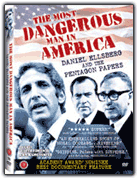
Ray McGovern comments at truth-out.org on the integrity of Edward Snowden in the face criticism that mirrors that directed toward Daniel Ellsberg and delivers Snowden a personal copy of “The Most Dangerous Man In America,” along with Ellsberg’s encouragement.
Read the complete article here.
America’s most famous whistleblower criticized the journalists attacking Glenn Greenwald in an interview with the New York Times. Daniel Ellsberg, the man who leaked the Pentagon Papers in 1969, slammed journalists Jeffrey Toobin and Michael Grunwald during a conversation with the Times’ media columnist David Carr.
“With Snowden in particular, you have a split between truly independent journalists and those who are tools — and I mean that in every sense of the term — of the government. Toobin and Grunwald are doing the work of the government to maintain relationships and access,” Ellsberg said.
Daniel Ellsberg, the military analyst who in 1971 leaked the top-secret Pentagon Papers detailing the history of U.S. policy in Vietnam, tells NPR’s Weekend Edition Saturday that unlike Bradley Manning and Edward Snowden, he “did it the wrong way” by trying first to go through proper channels — a delay that he says cost thousands of lives.
“I really regarded [it] as anathema … leaking as opposed to working within the system,” Ellsberg says, speaking to NPR’s Linda Wertheimer. “I wasted years trying to do it through channels, first within the executive branch and then with Congress.”
“During that time, more than 10,000 Americans died and probably more than a million Vietnamese,” Ellsberg says.
“That was a fruitless effort, as it would have been for Manning and Snowden,” he says.
Ellsberg, then an analyst with the RAND Corporation, leaked a study of U.S.-Vietnam relations from 1945-1967, known colloquially as the Pentagon Papers, handing over the document to The New York Times, The Washington Post and other newspapers.
The release of the Pentagon Papers proved politically embarrassing for President Richard Nixon and the Watergate break-in, which eventually led to Nixon’s resignation, was part of a broader White House effort to identify the source of such leaks.
Forty-one years ago, Beacon Press lost a Supreme Court case brought against it by the U.S. government for publishing the first full edition of the Pentagon Papers. It is now well known how The New York Times first published excerpts of the top-secret documents in June 1971, but less well known is how the Beacon Press, a small nonprofit publisher affiliated with the Unitarian Universalist Association, came to publish the complete 7,000 pages that exposed the true history of U.S. involvement in Vietnam.
The Pentagon Papers, which started the chain of events that brought down Nixon, had slipped to the back of my mind, and the man who leaked them, Daniel Ellsberg, had slipped right along with it. I couldn’t have said for sure that he was still alive until he started popping up and mouthing off as part of the Edward Snowden fiasco.
So I tracked him down to the place where he has lived for 35 years in the hills of Kensington, up above Berkeley, and sat down at his kitchen table to hear him spew venom . To read more, click here
Daniel Ellsberg’s Op-Ed in the Washington Post
Snowden made the right call when he fled the U.S.
Many people compare Edward Snowden to me unfavorably for leaving the country and seeking asylum, rather than facing trial as I did. I don’t agree. The country I stayed in was a different America, a long tim
Camouflaging the Vietnam War: How Textbooks Continue to Keep the Pentagon Papers a Secret
Like today’s whistle-blowers Bradley Manning and Edward Snowden, Daniel Ellsberg knew the consequences for his act of defiance. Ultimately, he was indicted on 11 counts of theft and violation of the Espionage Act. If convicted on all counts, the penalty added up to 130 years in prison. This story is chronicled dramatically in the film The Most Dangerous Man in America: Daniel Ellsberg and the Pentagon Papers, and in Ellsberg’s own gripping autobiography, Secrets: A Memoir of Vietnam and the Pentagon Papers.
We’re glad to see whistleblowers like Bradley Manning and Edward Snowden bringing awareness to this critical issue! Daniel Ellsberg has been weighing in as the “grandfather of all whistleblowers.”
Also, here’s a new 5 star review, “Still all too timely & necessary”
With several whistleblowers in the news lately, all of whom face immediate criminal charges & outraged excoriation by politicians & pundits across the board, it’s good to be reminded of history. What these young whistleblowers are doing today is precisely what Daniel Ellsberg did some 40 years ago. Both then & now, the whistleblowers were fairly conservative individuals at first, eager to be of service to their country … until they gradually became aware of the crimes being committed by their country, from shredding the Constitution to killing innocent civilians around the world.